
Illness Burden Placemat™: The One-Page View HR Leaders Need to Make Better Workforce Health Decisions
NEXTpert: Dr Ray Fabius, MD and David Kirshenbaum
This article introduces the Illness Burden Placemat™: a proprietary tool by HealthNEXT that brings data together in a one-page view of the most prevalent health risks, conditions, care needs, and high-cost patterns affecting a workforce. Based on a deep understanding of the science of population health management the HealthNEXT team developed this tool specifically for CHROs, HR and benefits leaders, and senior executives. This next generation analytic tool explains how to leverage the insights provided to set priorities, align existing resources with employee needs, and measure progress on a population scale over time.
From scattered data to clear priorities
HR leaders are expected to manage healthcare costs, support employee wellbeing, and show how those efforts contribute to business performance. But the necessary data is often scattered across health plans, vendors, and workforce reports, making it difficult to see where to focus.
That is where an Illness Burden Placemat™ can change the conversation.
Developed by the team at HealthNEXT, the Illness Burden Placemat™ is a single-page view of the most prevalent health risks, conditions, care needs, and high-cost patterns affecting a workforce and its covered population. It brings multiple data sources together to show leaders what matters most.
For HR and business leaders, it is not a clinical report. It is a decision-making tool that helps them prioritize investments, align workforce health efforts with business goals, and measure progress.
Why fragmented data limits strategy
Most employers do not lack data, they lack an integrated, actionable view. Viewed separately, data sources and vendor reports can produce a fragmented narrative:
- HRA and biometric screening data may reveal widespread health risks, such as elevated blood pressure or blood sugar.
- EAP reports may provide metrics for behavioral health prevalent concerns
- Claims data may show musculoskeletal conditions driving frequent care episodes.
- Pharmacy data may reveal substantial cardiovascular or behavioral-health medication use.
- Disability data may point to maternity, cancer, musculoskeletal conditions, or mental health as leading causes of lost work time.
- High-cost claims may be associated with cancer, cardiovascular disease, trauma, neurological conditions, or other complex needs.
An Illness Burden Placemat™ brings data from across these sources and other vendor reports together focusing on prevalence, rather than relying on claims reports that often emphasize cost over how many people are affected. Medical and pharmacy claims are usually not integrated, and prescription use may not be clearly attributed to a chronic condition. Health risk assessments and biometric screenings can add another piece of the puzzle: risks that may not yet appear in claims at all.
Looking across these sources helps leaders see both the conditions affecting employees now and opportunities to act proactively. The Illness Burden Placemat™ can identify prevalent risks, understand how those risks relate to care utilization and medication use, and target support before a risk develops into a chronic condition requiring treatment or contributes to disability or high-cost claims.
How the Illness Burden Placemat™ comes together
HealthNEXT typically works with the data analytics vendor to bring together information from health risk assessments, biometric screenings, medical and pharmacy claims, and other available reports. This often requires integration and analysis beyond the vendor’s standard reporting. The depth of the placemat depends on what the organization and vendor can provide and integrate.
When there is no integrated analytical support, the HealthNEXT team can still cross reference individual vendor partner reports and establish a baseline view
What an Illness Burden Placemat™ shows
While the precise layout can vary by organization and available data, an Illness Burden Placemat may look like the example pictured below:
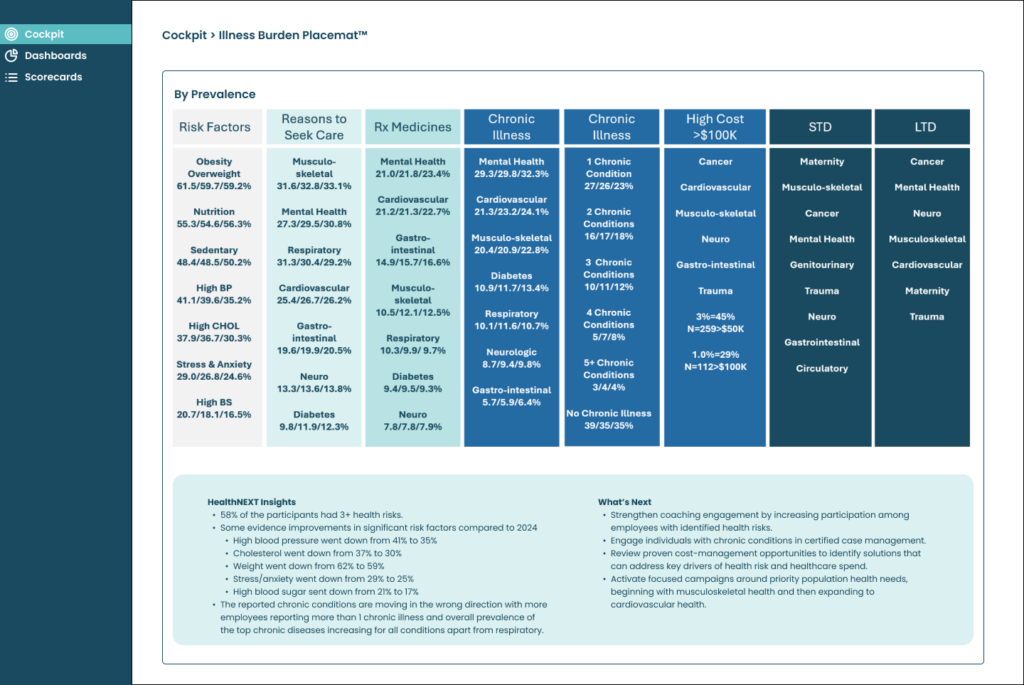
Each column features risks and conditions in order of prevalence. This a distinctively different than is normally provided by third party administrators, health plans or PBMs.
The Illness Burden Placemat ™ is a one-page view that:
- Describes the current state of population health and identifies key drivers of illness burden.
- Diagnoses where risk is concentrated across conditions, demographics, and population segments.
- Predicts emerging trends to identify risks and conditions likely to grow over time.
- Prescribes targeted actions to address priority risks and conditions, close gaps, and improve outcomes.
- Guides deeper analysis and intervention toward the areas with the greatest opportunity for impact.
Turning a one-page view into action
Once you have an Illness Burden Placemat™, the next step is to put its insights to work. You’ll work with your HealthNEXT NEXTpert: experienced physician executives, including former Chief Medical Officers and corporate medical directors who have led workforce health and wellbeing strategies at Fortune 500 organizations to assess your workforce’s needs, prioritize the greatest opportunities, implement targeted support, and measure whether those efforts are making a difference. The “placemat” informs strategy, often provides guidance for additional analytic studies and helps human resource and clinical leadership teams justify their investment in targeted programs and required resources to reduce the illness burden of the workforce and covered lives.
Assess: Understand what affects your workforce
The Illness Burden Placemat™ allows you to focus on the risks and conditions that can positively impact large cohorts of the workforce and covered lives. Start with the most prevalent health risks and reasons employees seek care and take medicines. Ask yourself how the organization can reduce these risks and health care needs to prevent future chronic conditions and catastrophic illness. Ask yourself how the organization can support the employees and dependent who already have chronic condition to mitigate high-cost claimants and disability. The answers to these questions will drive next steps in population health management,
Prioritize: Focus on the greatest opportunity
No employer can address every health issue at once. If mental health, musculoskeletal conditions, and cardiovascular risk all appear prominently on your placemat, consider how many people are affected and where earlier support could make the most difference. Then apply a Triple Aim lens: Which opportunity could most improve workforce health, make care easier for employees to access and use, and reduce avoidable costs or lost work time? The answer may be to improve the reach, coordination, or accountability of programs you already have rather than purchase another solution
Implement: Align resources to real workforce needs
Once priorities are clear, the placemat can guide the design of interventions across the population health continuum.
| Population segment | Primary goal | Examples of employer actions |
| At risk | Identify aggregate health risks and work to reduce them | Biometric screenings, health-risk outreach, coaching, behavior-change support, primary care connection, clear health communications |
| Chronic conditions | Improve condition control and prevent complications | Condition management, medication support, care coordination, adherence outreach, evidence-based targeted vendor programs |
| Complex or high-cost needs | Improve quality, coordination, and experience while avoiding preventable cost | Case management, navigation, advocacy, Centers of Excellence, expert opinions, specialty pharmacy support, high-quality provider access |
| Future high-cost risk | Identify rising-risk patterns before catastrophic events occur | Predictive and prescriptive insights, targeted outreach, early clinical support, proactive care management |
Measure: Learn what works and adjust
Track whether the people who need support are being reached, whether they can use the resources available, and whether health and care outcomes improve. Use what you learn to refine outreach, strengthen vendor coordination, and adjust priorities over time.
This cycle helps you address current complex needs while building a strategy to identify and support employees earlier.
From program manager to strategic workforce architect
The Illness Burden Placemat™ is ultimately about helping HR leaders lead a more integrated, proactive strategy. It gives you a common language for conversations with senior leaders, finance, brokers, health plans, and vendors. It also provides a practical way to connect employee health and wellbeing with business priorities: workforce performance, safety, retention, productivity, healthcare affordability, and employee experience.
HealthNEXT can support this work as a strategic partner—helping organizations integrate relevant data, interpret the workforce health story behind it with population health management expertise, identify the greatest opportunities for impact, and translate insight into an actionable, sequenced plan.
The goal of the Illness Burden Placemat™ is not simply to understand what ails your workforce. It is designed to help leaders address the prevalent risks and conditions so that workforce can be happy, safe, well and productive.